 |
| Have a look inside! |

Friday, April 18, 2014
Promo Catalog: Transportation

Tuesday, March 11, 2014
Winthrop Little Has Arrived!
Exciting news! The Memoirs of Winthrop Little has just been released on the App Store!


.jpeg)
.jpeg)
I had a really fun time creating the illustrations for this charming story about two teddy bears getting into all sorts of hi-jinx as they embark on Operation Birthday Cake!
Here are some shots of the app;
To purchase please visit the Winthrop Little Website or HERE on the App Store. Please spread the word!
Monday, February 24, 2014
Make it Work

The illustration was inspired by my son, who happens to be obsessed with trains at the moment. I wanted to share my process with everyone, so please follow along as I go from the initial sketch to the final illustration;
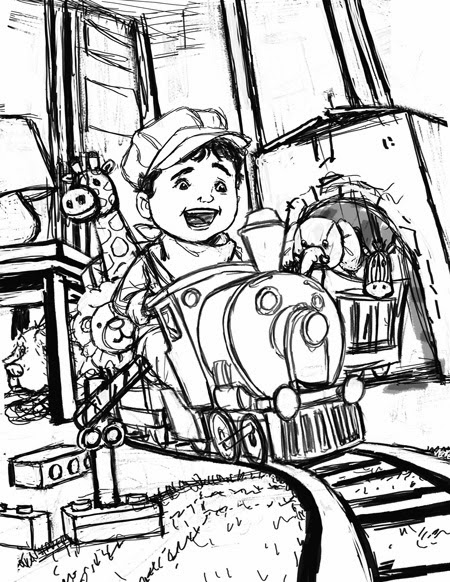 |
| With any illustration, I started with the sketch. This was done in Photoshop. At this point, I was still not completely satisfied with the background or the foreground elements. Typically, if this was for a client, I would make sure to resolve everything before moving on...however, since I was essentially doing this for my own indulgence, I decided to plow ahead and see where things would take me. One of the luxuries to being your own art director is that you get to explore and react to a piece as you are developing it. But before I moved onto colors, I duplicated my sketch layer. One layer, I left at the very top of my layer stack, this will be left invisible and set to multiply. This layer would only be turned on if I needed to refer to my sketch later on as I rendered. My second layer was put at the very bottom of my stack. |
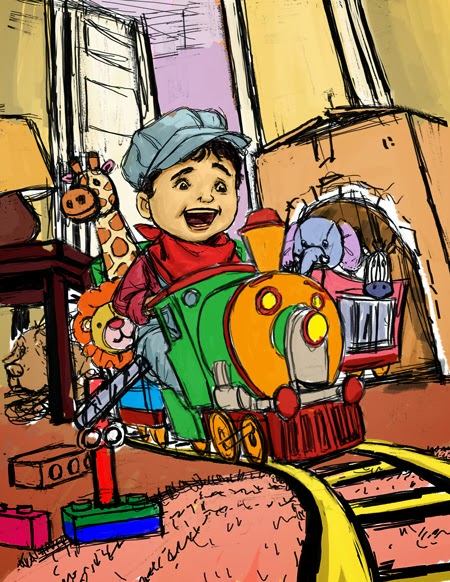 |
| The next step was to introduce colors. I laid down my basic local colors on a separate multiply layer. This layer is sandwiched between my two previous sketch layers. This way I was able to apply colors fast without having to worry about losing any of my line work. |
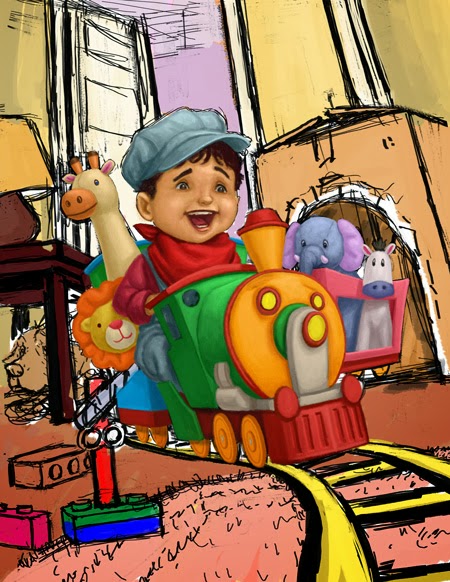 |
| From there, I created new layers for each object(i.e. boy, train, dolls, etc.), and I rendered out the main elements of the illustration. At this point, I only focused on the light and the form, still remaining in my local colors. I established my light source, which is coming from your upper-right hand corner. Since these layers were left as normal layers, I am slowly covering my line work underneath. |
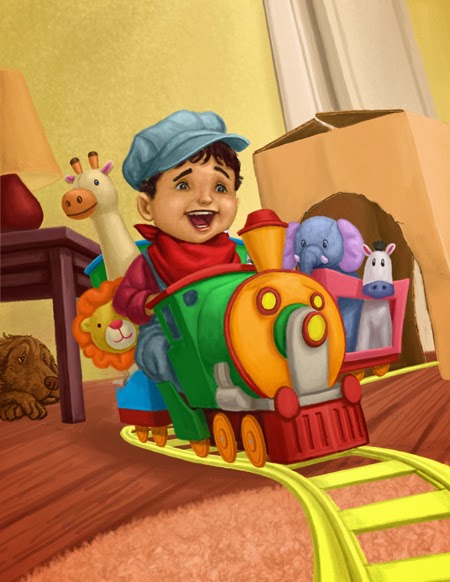 |
| I repeated the same process for the rest of the illustration, this included the background. As I began to add my door, I played around with the placement of it. And as soon as I placed it to the far right, I really liked what it did for the composition. Not only did it essentially open up the room and create more sense of depth, it naturally flowed with the way the tracks receded into space. Another change I decided to make was the direction my dog was facing in the corner. By flipping him over, I thought he now flowed more naturally with the direction of the action. |
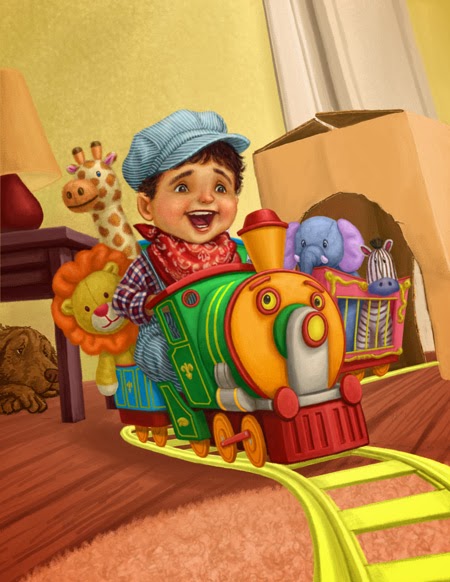 |
At this point I went back to my main elements and gave each a second pass. With my main forms and shapes already established, I am now free to focus on the details. Here's a detailed before-and-after of the boy. With the second pass of the face, I used a layer set to soft light to create the richness and the blush in the cheeks and nose. The soft light layer allowed me to glaze on color without losing any of the brush work underneath. And I'm always amazed at how a couple simple touches of color can bring a face to life. With the patterns and designs on the fabrics, I used a blend of overlay, soft light, and color layers. This was made easier by creating clipping masks for the separate patterns. Below is a screen shot;  (The clipping mask are represented by the arrows pointing down to it's "parent" layer, this is why some refer to this as "parenting") By parenting my layers, it allowed me to freely make strokes without worrying about the marks breaking beyond the silhouette of the parent layer. I played with the opacity and the blend of each layer until I came up with a combination I liked. |
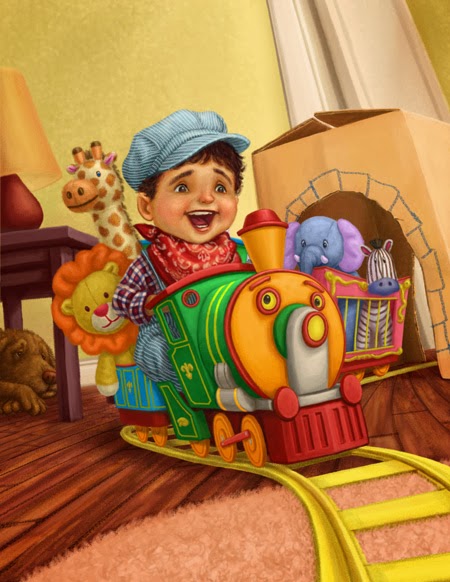 |
| With the details of the main elements done, I turned my attention to the background. The detailing was accomplished much in the same way. |
 |
| With the main parts of the illustration addressed, I focused my attention to the foreground. At this point of the process, I had hoped to have a clearer idea of what to do, but that wasn't the case. So a lot of this was done through trial and error. I played with the idea of adding several different toys, from legos, to plastic trees, marbles and even a pillow. Finally I ended up with this makeshift guard rail. I thought compositionally, it helped to further direct a viewers eyes through the illustration. In addition, I also, included a hint of a couch on the left, and the ceiling trim at the upper-left corner. These served as part framing element and further established that this is a living room. |
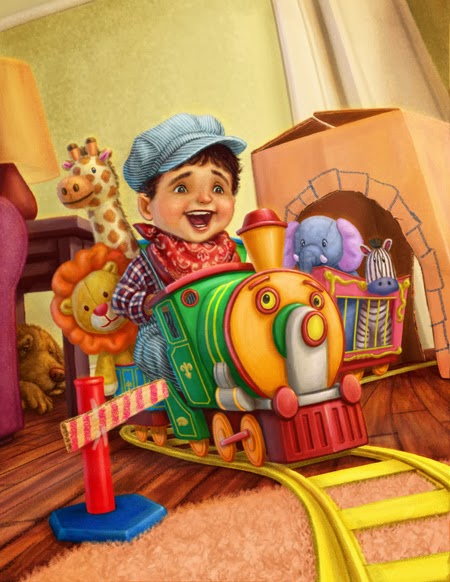 |
| All there was left to do was the finishing touches. I added the brightest highlights to punch things up. These were mainly reserved for the specular highlights on the train. I also added a cooler light source coming from the left. This gave the objects that extra bit of volume, as well, it helped unify everything. Lastly, I made some minor adjustments here and there and I officially called it one completed. |
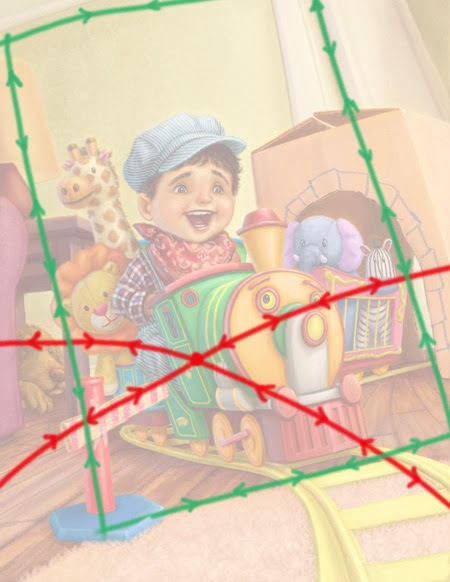 |
| Highlighted are the directions a viewer's eyes travel through the composition. In both cases, I have created movement drawing the eye back to the main focal point, which are the boy and the train. |
Overall, I am really satisfied about how my illustration turned out. And I'm especially happy with the composition. Although, I didn't have everything planned right from the get-go, I continued to search for solutions as I painted. I have often praised this medium for the freedom it gives me when it came to editing. I can play and test things without any worry, and with my illustration, I really took advantage of.this. The lesson I learned here is to remain open to experiment, and not to just settle on the first thing that comes. And if this means deviating from the sketch, go for it. In short...just Make it Work!
Monday, January 20, 2014
Breaking Into the Biz

For my first post for Once Upon a Sketch a couple months ago, I wrote about tips on how to build a solid portfolio (Here's the link). With the relaunch of the site, I figured now would be a good time to continue that theme and so today’s topic will be “Breaking into the Biz”; what to do once you have that portfolio. Although, I think having a strong portfolio is still the most vital part in landing work, having the best portfolio won't help you one bit, if your work never gets in the hands of the people who need to see it! So here is a list of ways to get your work out there and get your foot in the door:
- Digitally - Your portfolio in digital format:
- Website - In today's world, it's practically a requirement to have a website of some kind where you can showcase your work. Not only does a website serve as a digital representation of your physical portfolio, it's also the most efficient way to reach the masses. Here are a few general ideas to keep in mind when designing your website:
- Remember your website is merely a means of highlighting your art, so like your physical portfolio, the art is what's important! So your site must be clean and simple to navigate. It's okay to have a few bells and whistles to spruce it up, but keep in mind that people generally have very short attention spans (for instance, mine is about 3 seconds), so if your site takes forever to load because of a fancy animation, it's not doing you any favors. Also, a good rule of thumb is to make sure your artwork is accessible by no more than two clicks of a mouse.
- One of the benefits of having your own website is that you are not limited to 12-16 images. So you can be more liberal about what you want to include in your site. But keep in mind that you'll want to make sure your best work gets seen, so make sure they are placed where people will see it first.
- The style of the site matters too. Meaning the overall look of your site should share a similar style to your art. Not only does it make for a more single, cohesive and harmonious package, you won't confuse your viewers.
- Your work should be categorized appropriately. It seems pretty obvious, but you should definitely arrange your work in a logical and orderly fashion...I can definitely spend all day talking in detail with suggestions about grouping and organizing your artwork, but that could be a whole post in and of itself.
- Blog - A blog is a good way to interact and connect with people of similar interests. A blog can be your digital journal, where you can write about anything relevant to your craft. However, a blog can also serve as a good addition, or possibly in place of your website altogether. If you happen to be someone who doesn't have the knowledge or access to creating a website of your own, then you can simply fashion your blog like one. Not only are they easy to design, by creating "posts" that can act as the categories in a website (i.e. portfolio, bio, books, etc.), it can still achieve in getting your work seen.
- Directories - There are a number of websites out there that specifically advertise to Art Directors and other interested parties. Picture-Book and Childrensillustrators are two that come to mind that cater to the children's market. For a fee, you can have your portfolio be included. Some of these websites also provide printed material but I will discuss that below in the print category. I personally have mixed feelings about sites like these and their effectiveness. Because of the nature of how these sites work, you are put in a sea of hundreds of other illustrators without much control as to who sees your work. I'm sure if you ask around, you will also find testimonials of illustrators finding work this way as well, so it does happen. I suggest you weigh the cost versus the benefit.
- Social media - Whether it's Facebook, or Twitter, or Pinterest, it's all about getting your name and work out there in cyberspace...cause you never know who's watching. Facebook for example, has a myriad of groups you can join that cater more specifically to others that share your interests. These can be a great networking tool and a way to direct traffic to your site and ultimately your work. The best part is that they don't require a lot of work, time or cost on your part.
- Forums - A forum is an extension of social media, you are again networking, making a name for yourself and getting your work out there with people that share your interest. If nothing else, sometimes it's just nice to have a place to talk shop, share stories, or get feedback from others that can relate.


- Physically - With your bound portfolio in hand:
- Conferences - For those looking to get into children's publishing, SCBWI (Society of Children's Book Writers and Illustrators) is probably the first name that comes to mind. Not only do they hold two big conferences each year, the regional chapters also hold many events in your area. At these functions, you will be able to meet with art directors, agents, other illustrators and other key players in the field. Some of these conferences will even give you an opportunity to sit down face to face with one of these people and have them view your portfolio. Definitely a rare thing in this day and age...which leads me to the next item on the list.
- Face to face - If you happen to be fortunate enough to be in the position to meet with an Art Director in person definitely make the most of it. Treat it like a job interview, because for us, this will be the closest thing to it . So be prepared, courteous, and most of all, PROFESSIONAL! Back when I was fresh out of college, this was more of the norm; to track down the phone numbers and email addresses of Art Directors you want to work with and try to set up a meeting. I suppose these still can and do happen today, but due to an ever increasing fast-paced world, I would guess most would rather you send them work electronically or through the mail. However, be on your toes! I once had an impromptu meeting with a publisher at a dragon boat race, so you never know when lightning will strike.

- Print-based - Snail mail:
- Postcards/promos - I'm personally a fan of postcards. When it comes to deciding on the art, It should certainly be a stronger, if not the strongest piece in your portfolio. Obviously, your postcard is meant to be a tiny sampling of your collective work and skill set. Choosing a piece that best represents this is critical. Here are some other common questions when it comes to postcards;
- Does size matter? Yes and no. Honestly, I think it really comes down to personal preference. And not just the preference of the sender, but also the recipient. I have heard some Art Directors in favor of your traditional 4x6 postcards while others say something larger has more impact. For the sender, the additional cost of the printing as well as the postage is something to consider. Ultimately, regardless of whichever size you decide, it's about the image you choose.
- How often should I send one? Again there's no written rule here, the consensus seem to dictate somewhere between 1-4 times a year. Personally, I would base my answer on what image I have to use, as well as how updated my portfolio is at that particular time. Let me elaborate; to me, I liken a postcard to a teaser or a trailer to a movie. The goal of a trailer is to amp up your audience before seeing the movie and entice a viewer to then go watch the film. For us the goal is the same, the illustration we choose needs to WOW a viewer and get them to go check out more of our work. So to make it worthwhile, we need to be very selective, otherwise, your card will just get tossed in with the pile of others. Furthermore, you should also consider the state of your portfolio, for instance, if someone sends out 4 postcards a year but fails to update or add more pieces to their portfolio, then you are ultimately selling the same product over and over again. To use my movie analogy, it's kind of like showing trailer after trailer to someone who has already seen the movie. So you definitely need to ask yourself; is your "movie" worth seeing multiple times. If not, I would make sure you have something new to show.
- Directories - Similar to their digital counterpart, the premise is the same. You pay for a spot and they include you in their book. Some companies, like Picture-Book, host both a website and an annual printed directory. These directories are sent to all the publishing houses. One trend I have noticed is that with the decline of the economy these past couple of years, the amount of pages these directories hold has also declined. This may or may not be a good thing because now you have less competition, but this may also mean that they might be falling out of favor to some. Again I would weigh cost versus benefit.
So here are my suggestions on how to get your work out there. Of course, these are not to ONLY ways to go about it, I'm sure we have all heard of stories about talent being discovered in the oddest of places. My advice to everyone is to do as much as you can within your budget. But regardless of what you choose, the one thing that holds true about everything I've mentioned is that all of it takes a proactive attitude. And once you find some success, this attitude doesn't change because just like your talent, you have to continue to work and nurture it and continue to get better at it. The reality of it is, there are no secret handshakes and it's not even about who you know, the formula is simple; create a strong portfolio and then go out there and get it in front of the right people. Good luck out there!
Wednesday, January 1, 2014
Once Upon a Sketch
Happy New Years! Looking forward to a new year filled with new adventures. With that in mind I'm delighted to announce that Once Upon a Sketch is back and I am thrilled to be part of this wonderful, collaborative team of talented professionals. One thing I learned this past year was the importance of networking with other creative types like myself, not only was it nice to share common ideas and frustrations, but it was motivating to contribute in some small way to the world of children's publishing.
Please check out the site!

Please check out the site!
And to close out the year, again I traded in my digital brushes for real ones and I painted a watercolor portrait to celebrate the life of a name I only knew from stories told by my wife. Stories about biker rallies and Alaskan fishing adventures. Here's to you George.

Subscribe to:
Posts (Atom)